Talk, play and notice growing skills
Play & development
Talk, play and notice growing skills
Sources checked · Editorial guide

From two to four years, children often want to talk, try, pretend and do things “myself”, while still needing help with many ordinary tasks. A useful approach is to offer chances to practise, notice what your child does and raise concerns without turning home into a testing centre. This guide brings play, communication and preparation for checkups together.
Look at several areas of development
The Canadian Paediatric Society describes development across movement, hand skills, communication, social interaction and thinking. Its age examples include combining words around two, growing pretend play and conversation, and increasingly complex movement and problem-solving through the preschool years. These examples help start a conversation; they cannot assess an individual child or explain a concern by themselves. [1]
HealthLink BC also describes physical, social, emotional, cognitive and language development as connected areas. Warm back-and-forth interaction follows what a child communicates and responds with attention and support. You can include this in ordinary routines rather than treating each area as a separate lesson to complete. [2]
Choose one recent observation from each part of everyday life: something your child says, something they try with their hands, how they move, how they play with others and what they do when a task is hard. Record examples, not scores. This gives a fuller picture than counting only words or letters.
Make conversation part of doing things together
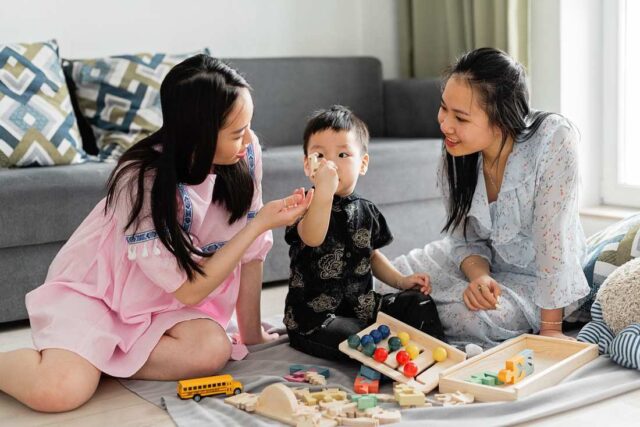
Use an activity the child already enjoys. While building, you might say, “You put the big piece at the bottom,” then pause for a response. If the child says “more blocks”, respond to the meaning and continue the exchange. You do not need to correct every sentence or turn the game into repeated questions.
For a child who communicates through gestures, signs or another communication system, make space for that response too. Ask their care team or speech-language professional how to support their particular needs. A spoken answer is not the only way a child can participate.
Invite storytelling about something familiar: a trip to the shop, a grandparent’s visit or what a toy character is doing. Let the child contribute a small part. If the story changes each time, you can enjoy the invention without requiring a factual report.
Offer play with room for the child’s ideas
Create a simple invitation using suitable, inspected materials: a small set of blocks, a pretend meal with age-appropriate toys or a sturdy picture book. Stay available but allow the child to choose what happens. If the blocks become a garage instead of the tower you imagined, follow that idea where it is safe.
Try an original “repair shop” game. A toy vehicle has a pretend problem, and the child chooses what the mechanic does. Use only safe toy materials; real tools, loose screws, button batteries and small parts belong out of reach. You can take turns being the customer and mechanic without needing a commercial play set.
Another invitation is a “story basket” with a few suitable large objects or toys. Choose one and make up a tiny story together. The activity can last a minute or much longer depending on interest. Put the materials away if the game becomes unsafe or the child is finished.
Practise everyday independence in small pieces
Pick one part of a task the child can try with appropriate help: choosing between two outfits, carrying a light item or putting a book back. Prepare the task so an adult can step in safely. “You start, I will help with the hard part” can be more workable than expecting the child to complete the whole routine alone.
For example, dressing can be divided into choosing, finding the opening, trying an arm and asking for help. Allow extra time when you invite practice. On a rushed morning, it is reasonable to offer more help rather than turning the task into a struggle over independence.
Praise the specific effort you noticed: “You kept trying to turn it around.” You do not have to label every result brilliant or compare it with a sibling’s work. Keep the focus on participation, trying and asking for help when needed.
Prepare for shared play and preschool routines
HealthLink BC’s preschool guidance discusses growing independence, language, relationships and support for new experiences. Children differ in how they approach groups and transitions. Ask about the routines and support at a preschool or childcare setting instead of assuming every child should arrive with identical skills. [3]
Before a new setting, find out practical details: toileting help, clothing, food, communication methods and how the caregiver contacts you. Share relevant support needs through the service’s appropriate private process. Avoid sending a long diagnostic history to a general group chat.
At home, you can practise a small arrival sequence or look at a picture of the setting if available. Keep the explanation concrete. A child may still feel upset at a transition; preparation is a support, not a guarantee that goodbyes will be easy.
Bring concerns forward with examples
Ask a health professional when a skill seems difficult, communication is not progressing as expected or something about movement, play or interaction worries you. Loss of previously used speech or language skills needs prompt assessment. Do not assume a concern will resolve solely because children develop differently; variation and the need for assessment can both be true. [4]
Write what happened, when you first noticed it, the settings where it occurs and what help makes a difference. Ask whether hearing, vision, speech-language or developmental assessment is appropriate, and how to follow up on a referral. A provider can help interpret the observations in the context of the whole child.
Your next small step
Choose one shared activity, one everyday task to practise and one observation to bring to the next visit. Keep the plan enjoyable and realistic. Children do not need constant adult-led enrichment, and parents do not need to buy a new learning product for every skill. A warm relationship, usable opportunities and timely individual support provide a more useful starting point.
Sources and further reading
Our practical examples and planning tools are original editorial suggestions. Health and safety points are linked to the Canadian sources below. Checked October 20, 2026; this article has not been medically reviewed.
General education for parents and caregivers. These guides do not assess your child or replace care from a qualified professional. For advice about your pregnancy or child, contact your care team.
Stay a little longer
More for this chapter.

Everyday care
Toilet learning at your child’s pace
Look for readiness and make practice comfortable, calm and pressure-free.

Play & development
A day with room to move, rest and play
Make space for activity and rest, with different sleep needs at two and at three to four.
Play & development
First friendships: play, turns and room for feelings
Set up manageable playtimes and coach the moments children cannot yet solve alone.