Little conversations, books and first-year play
Play & development
Little conversations, books and first-year play
Sources checked · Editorial guide

A little conversation with a six-to-twelve-month-old might include a sound, a glance, a wave or a hand reaching for a book. You do not need a scripted lesson. This guide offers ways to make those small exchanges part of meals, changes, play and getting out of the house, while leaving room for your baby to take a turn.
Notice the conversation already happening
The Canadian Paediatric Society describes “serve-and-return” interaction: a baby makes a sound, gesture or expression, and an adult responds. Speaking, singing, signing and sharing books all offer ways to connect. Use the language or languages in which you are most comfortable interacting, and follow the baby’s interest rather than trying to teach a fixed number of words. [1]
Pick one routine you already do together. During a diaper change, you could name what is happening, pause when the baby makes a sound and respond to that sound. On a walk, you might describe a dog the baby is watching. You do not have to provide running commentary for the whole day.
Try a practical reminder: say something, pause, notice, respond. Pausing does not mean waiting for a correct answer. A look or movement can be enough to continue. If the baby turns away or becomes upset, change the pace or attend to their care needs.
Make books easy to reach and easy to stop
Choose a small number of sturdy, appropriate books and a place where you can sit comfortably together. You might keep one by your usual chair and another with the play items. Check them for damage before offering them, particularly if they are often mouthed or shared with older children.
You do not need to finish the whole book. For example, if a baby keeps returning to one animal picture, spend time on that page. You can name the animal, make a gentle sound or connect it with something you saw outside. If the baby closes the book, that can be the end of this reading moment.
A library visit can help you try different formats without committing to a large purchase. Check the library’s actual age guidance, programme times and borrowing rules. If getting out is difficult, ask what borrowing or family services are available rather than assuming you need to buy books online.
Try three ordinary conversation games
The dressing conversation: Hold up the next item, name it and describe the action. “Here is your sock. Now your foot.” Pause if your baby responds. You are sharing the routine, not testing whether they can identify clothing.
The familiar-song pause: Sing a short song your household enjoys. Leave a small pause at a familiar moment and notice the baby’s response. Continue whether they make a sound, move or simply watch. Keep the experience playful rather than repeating the pause until you get a particular result.
The object story: With a suitable object in supervised play, describe what the baby is doing: “You put the cup down. I can see it.” If it becomes a dropping game, decide what is practical for the setting. You can participate without turning a restaurant meal or every household task into a long activity.
Make room for play without more equipment
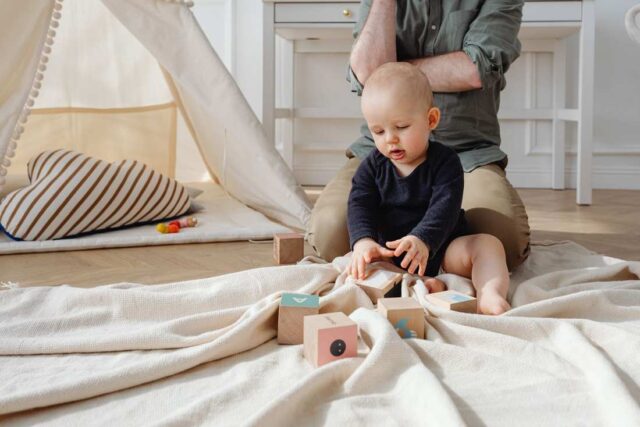
HealthLink BC encourages a mix of active and quiet play, following a child’s interests and allowing breaks. Toys can be simple and need not be expensive. They should be well made, suitable for the child’s age and free of small, broken or loose parts that could cause injury. [2]
Put out a few suitable items and notice what the baby chooses. One day the interesting part may be your reaction; another day it may be turning an object over. If you rotate toys, keep the stored items secure and check them again before bringing them back. There is no need to replace everything each time an age filter changes.
For another caregiver, write down one familiar song and one book the baby enjoys. This can make a handover easier and let different family members participate in their own language or style. Nobody needs to imitate a professional presenter to make shared play worthwhile.
Use screens deliberately
The Canadian Paediatric Society does not recommend routine screen use under age two, with an exception for video chats with caring adults. Babies benefit from direct interaction with caregivers. Background television and adult phone use can also interrupt shared time, so consider one small change that makes the routine easier to attend to. [3]
For example, put the phone on a shelf during a short reading moment, then check messages afterwards. If you are arranging a family video call, stay with the baby and help connect the familiar face with the conversation. You do not need to make every quiet moment into entertainment.
Know when an observation deserves a conversation
If you are concerned about hearing, speech, language or development, talk to your child’s provider even if earlier hearing screening was normal. The Canadian Paediatric Society explains that hearing difficulties may not be obvious and that follow-up matters. Do not rely on a baby responding to some sounds as proof that hearing is fine. [4]
Write a concrete example, when you noticed it and whether it happens in different settings. Ask what assessment or referral is appropriate and when to follow up. Avoid repeatedly testing the baby with loud noises or turning a milestone list into a home diagnosis.
A simple plan for the coming week
Choose one familiar song, one accessible book and one routine where you can pause for a response. Invite another caregiver to share their own version. Notice what your baby enjoys, keep play safe and bring concerns to a professional. Useful interaction can be brief, warm and woven into the day you already have.
Sources and further reading
Our practical examples and planning tools are original editorial suggestions. Health and safety points are linked to the Canadian sources below. Checked October 20, 2026; this article has not been medically reviewed.
General education for parents and caregivers. These guides do not assess your child or replace care from a qualified professional. For advice about your pregnancy or child, contact your care team.
Stay a little longer
More for this chapter.

Feeding
First foods, iron and safer mealtimes
Offer variety while paying attention to texture, supervision and your baby’s cues.
Safety
Make room for a newly mobile baby
Revisit your home as reaching, rolling, crawling and pulling up change what is accessible.

Safety
Baby outings: feeds, sleep, transport and a lighter bag
Plan a manageable trip without turning every outing into a major packing project.